Unlocking the Benefits

Private Drug Coverage’s Role in Canada’s Healthcare Landscape

The Value of Private Drug Coverage in Canada

More than 27 million Canadians – nearly 70% of the population – rely on private drug plans offered through their employer for access to medicines and vaccines.

According to the Conference Board of Canada, 97.2% of Canadians are eligible for prescription drug coverage through either private or public plans.

Value in the Workplace

Private drug plans are a core component of many employers’ total compensation packages. Investing in employee health helps organizations:

  • Attract and retain top talent
  • Reduce absenteeism and disability claims
  • Improve productivity and engagement through better presenteeism

Read more

A comprehensive drug plan supports a healthier, more productive workplace.

Read less

Value Of Innovation And Comprehensive Access 

New discoveries continue to transform how healthcare professionals treat, and in some cases even prevent, serious diseases. As drug development advances, new therapies are emerging for conditions that were once untreatable.

Read more

Incremental innovation small but meaningful improvements to existing medicines can improve quality of life, treatment adherence, and patient choice. When multiple therapies exist within the same class, physicians can tailor treatment to individual needs, which is essential because patients often respond differently to different medications.

Offering a range of treatment options leads to better health outcomes, often without increasing costs. This breadth of access to new medicines is one of the key advantages of private drug plans.

Read less

Value Of Managing Risk

As more complex and specialized medicines enter the market, plan sponsors face growing pressure to  manage financial risk. Small plan sponsors outside of Quebec that purchase fully insured coverage plans can be particularly vulnerable to the financial impact of high-cost drug claims.

Read more

To manage these pressures, some sponsors reduce coverage by:

  • Restricting available therapies
  • Limiting benefit maximums
  • Imposing annual or lifetime caps

While these measures can reduce short-term costs, they can limit access to necessary treatments, potentially increasing long-term disability and other costly health outcomes.

Risk management and pooling mechanisms help distribute the cost of high-value claims across larger populations. Outside Quebec, participation is voluntary and methodologies are not publicly shared. In Quebec, mandatory participation for all plans with fewer than 6,000 covered lives provides greater stability and transparency. Modernizing risk-management tools outside of Quebec has become critical to maintaining high-quality health benefits for employees

Read less

Why Private Drug Coverage Matters

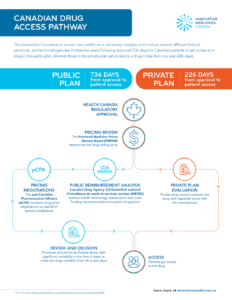
Private drug plans typically offer faster and broader access to new medicines than public plans. This timely access improves productivity while reducing the burden on the broader healthcare system.

Comparing Public to Private Drug Plans

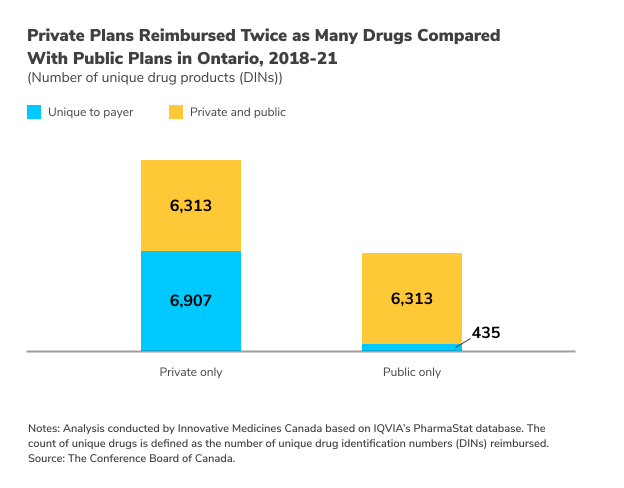
Private drug plans give access to twice as many medicines as public plans and offer significantly faster access to new medicines. This ensures plan members and their families receive the right therapy at the right time.

Public drug plans serve different populations, primarily seniors and individuals supported by social programs. Their purpose is to manage coverage within a fixed budget to achieve population-wide health objectives. Unlike private plans, they are not designed to prioritize rapid access or workforce productivity.

Access Delays

Canadians relying on public plans wait an average of two years to access newly approved medicines. This is much slower than many comparable countries across the globe. Canada currently ranks last in the G7 for time-to-access under public plans.

Access Erosion

Historically, private plans covered new medicines shortly after Health Canada approval. Recently, some insurers have begun adopting public-sector evaluation tools, such as health technology assessments (HTAs). While intended to manage cost, these tools can delay or restrict access to new medicines with significant benefits for Canadians.

Because private drug plans serve a different population and meet different needs, maintaining fast, comprehensive access is essential to their value.

resources

Discover. Learn.
Understand.

Stay informed with timely, relevant content on key issues shaping our industry.